
5G Industrial Routers Empowering Enterprise Networks: Architecture, Scenarios, and Best Practices
- Admin
- 8. Apr.
- 10 Min. Lesezeit
Table of Contents
Comparison and Positioning of Three Products
4.1 WR575: General-Purpose Enterprise Network Access
Typical Enterprise Network Application Scenarios
5.2 Enterprise Backup Link (Failover)
5.3 Video Surveillance Network
5.4 Retail and Chain Store Networking
Future Trends: 5G + Edge Computing + Enterprise Network Convergence
1. Enterprise Network Development Trends
Enterprise networks are undergoing profound structural transformation. Four converging forces — cloud computing, mobility, IoT proliferation, and commercial 5G deployment — are reshaping the fundamental requirements businesses place on their networks.
Cloud migration has changed traffic models. As enterprise applications shift from internal data centers to SaaS platforms, traffic destinations have become highly dispersed. Traditional MPLS hub-and-spoke architectures centered on the data center are increasingly misaligned with business realities. The explosive growth of IoT devices has introduced unprecedented endpoint heterogeneity — cameras, PLCs, sensors, and AGV robots simultaneously connecting to enterprise networks, with communication protocols ranging from TCP/IP to Modbus and MQTT — demanding that edge network devices support multi-protocol convergence.
At the same time, the tolerance threshold for network downtime continues to drop. The cost of point-of-sale outages or factory line stoppages has rendered "best-effort" single-link solutions unacceptable. Active redundancy and fast failover have become baseline requirements. The core themes driving enterprise network evolution can be summarized in four points: flexibility, redundancy, multi-protocol convergence, and centralized manageability — which are precisely the design principles behind 5G industrial router products.
2. How 5G Technology Reshapes Enterprise Network Architecture
The impact of 5G on enterprise networks goes beyond providing faster wireless access — it fundamentally changes the logic and possibilities of enterprise networking.
Deployment speed leap. MPLS dedicated lines take 4–8 weeks to provision. A 5G router, once powered up with a SIM card inserted, auto-downloads its configuration via TR-069 and completes network access within 20 minutes — completely overturning the networking logic for remote locations or time-sensitive scenarios.
Cost structure reshaping. 5G enterprise data plan costs are significantly lower than equivalent-bandwidth wired dedicated lines in most small-to-medium branch scenarios, with pay-as-you-go billing that eliminates the fixed monthly lease burden of dedicated lines.
Link quality upgrade. 5G Sub-6GHz average downlink speeds have reached hundreds of Mbps, with latency in the 10–30ms range. Mainstream enterprise applications including video conferencing, cloud desktops, and ERP access can all be handled smoothly. Cellular links have graduated from "backup" to a viable "primary link" option.
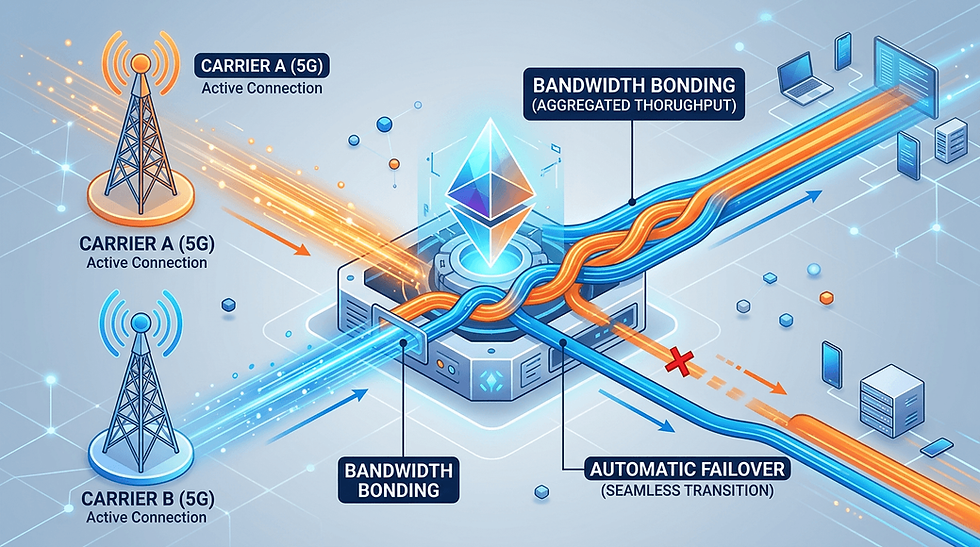
Dual-link aggregation raises the high-availability ceiling. Dual 5G module routers connect two links via different carriers. In Active-Active mode, bandwidth is aggregated while simultaneously providing redundancy. In the event of a failure, no switchover action is required, making the impact on services virtually imperceptible — delivering reliability comparable to dual dedicated lines for critical sites.

3. Core Capabilities of Industrial-Grade 5G Routers
Environmental resilience. Aluminum alloy enclosure, operating temperature range of -40°C to 75°C, IP30 protection, and DIN rail mounting ensure stable long-term operation in demanding environments such as server room cabinets, factory floors, and outdoor enclosures.
Multi-WAN and failover. Simultaneously monitors link quality on both wired WAN and cellular WAN ports. Upon primary link failure, switchover occurs within seconds. VPN tunnels are rapidly reestablished via the DPD mechanism, transparently to upper-layer applications.
Full VPN protocol coverage. IPSec, WireGuard, OpenVPN, GRE, L2TP, and DMVPN — compatible with mainstream enterprise firewalls and SD-WAN platforms, without vendor lock-in.
Industrial interfaces and protocols. RS-232/RS-485 serial ports connect directly to PLCs and instruments. Modbus TCP performs register data collection. MQTT Gateway pushes data to enterprise IoT platforms. DI/DO/AI/RELAY interfaces connect physical sensors and actuators directly, giving the router the additional role of an industrial edge gateway.
Enterprise routing protocols. BGP, OSPF, RIP, VRRP, and NHRP support dynamic routing and device redundancy, enabling seamless integration into enterprise backbone routing.
Centralized management. TR-069, SNMP, SSH, Web GUI, and RMS cover the complete operations workflow — from bulk automated configuration to real-time monitoring and alerting.
4. Comparison and Positioning of Three Products
WR575 is the balanced choice for general-purpose enterprise branch scenarios. With 3 Gigabit LAN ports plus 1 PoE-PD Gigabit WAN port (capable of drawing power from an upstream PoE switch), Wi-Fi 6 dual-band access, RS-232/RS-485 serial ports, and a complete I/O interface set (7DI/2DO/1AI/1RELAY), it integrates all the fundamental capabilities of a branch network into a compact form factor. Suitable for general branch networking, cellular backup, and OT data acquisition — the most cost-effective entry-level choice.
WR578 combines all the functionality of the WR575 with 4 PoE-PSE Gigabit ports (802.3af/at, up to 30W per port), enabling the router to simultaneously serve as both a network access device and a terminal power source. A single cable transmits both data and power, eliminating the need for separate power cabling for PoE endpoints such as cameras and APs. Suitable for security surveillance, wireless AP deployment, and integrated chain-store networking. Its core value proposition is "fewer devices, less installation work, lower cost."
WR677-D features dual 5G modules with Active-Active simultaneous activation, a 2.5GE port, 4 GE ports, 1 SFP fiber port, Wi-Fi 6 AX3000 dual-band, and the most comprehensive I/O interface set (11DI/2DO/1AI/2RELAY + ignition signal). The two 5G links can connect to different carriers — under normal conditions bandwidth is aggregated; upon failure, immediate switchover occurs. Supports BGP, OSPF, VRRP, and DMVPN for integration into enterprise dynamic routing. Suitable for zero-downtime-tolerance scenarios such as financial branches, medical institutions, and manufacturing control rooms.
Core Specifications Comparison of the Three Products:
Dimension | WR575 | WR578 | WR677-D |
5G Module | Single module | Single module | Dual module (Active-Active) |
Ethernet Ports | 3×GE + 1×PoE-PD GE | 4×PoE-PSE GE (30W/port) | 1×2.5GE + 4×GE + 1×SFP |
Wi-Fi | Wi-Fi 6 dual-band | Wi-Fi 6 dual-band | Wi-Fi 6 AX3000 dual-band |
I/O | 7DI/2DO/1AI/1RELAY | 7DI/2DO/1AI/1RELAY | 11DI/2DO/1AI/2RELAY + ignition |
Positioning | General branch access | PoE edge aggregation | High-availability core node |
5. Typical Enterprise Network Application Scenarios
5.1 Branch Office Networking
5G routers transform branch connectivity from "waiting for a dedicated line" to "plug and play." WR575 or WR578 units auto-complete configuration via TR-069 upon power-up, with VPN tunnels encrypting traffic back to headquarters. Employees accessing the corporate network remotely experience no difference from working at headquarters. For third- or fourth-tier cities or remote sites where dedicated line costs are prohibitive, 5G primary-link solutions are significantly superior to wired dedicated lines in both provisioning speed and total cost.
5.2 Enterprise Backup Link (Failover)
WAN Failover is the most common enterprise deployment scenario. Upon wired link failure, the router automatically switches to 5G cellular backup; once the wired link recovers, it automatically switches back — all without human intervention. The dual-SIM design provides secondary redundancy at the carrier level. When the primary carrier experiences an outage, the router automatically switches to the backup carrier, reducing the probability of a complete connectivity failure to an extremely low level.
5.3 Video Surveillance Network
The WR578's PoE + 5G combination is the optimal solution for security surveillance scenarios. Cameras draw power via PoE ports while transmitting video data; the video stream is then backhauled via 5G to the enterprise NVR or cloud platform, eliminating the need for power cabling. With 4 channels of 1080P cameras (approximately 4 Mbps each), the total upstream bandwidth requirement is around 16–20 Mbps — easily covered by 5G uplink capacity. Deployment costs and construction timelines are substantially lower than traditional wired solutions.

5.4 Retail and Chain Store Networking
WR578 meets all networking needs of a store with a single device: PoE ports power APs, cameras, and digital signage; the 5G primary link ensures uninterrupted POS transactions; VPN tunnels encrypt traffic back to headquarters systems; VLAN isolation separates employee networks from guest Wi-Fi. TR-069 centralized management enables headquarters IT teams to uniformly configure, upgrade, and troubleshoot devices across all stores nationwide without on-site presence — completely decoupling operations efficiency from store count.

5.5 Smart Manufacturing and Industrial Network
WR575 or WR677-D aggregates shop floor PLC data via RS-485. The Modbus TCP client polls registers at configurable intervals, and the MQTT Gateway packages and pushes the collected data to the industrial IoT platform — no additional protocol conversion gateway required. WR677-D's 11 DI channels can simultaneously connect multiple types of sensor signals; relay outputs drive audible/visual alarms; the ignition signal supports vehicle-mounted equipment such as AGVs — well-suited for central control rooms with complex connectivity requirements.
5.6 Mobile Offices and Temporary Networks
Scenarios such as trade shows, construction site project offices, and emergency command centers cannot rely on dedicated lines. WR575 is online as soon as it is powered up out of the box. Wi-Fi 6 supports concurrent connections for dozens of devices, with VPN tunnels providing end-to-end encryption. Equipment can be reclaimed and reused after the engagement, bringing deployment and teardown costs close to zero — the standard solution for time-sensitive temporary networks.
6. Enterprise Network Architecture Design
Based on 5G industrial routers, enterprise networks can adopt three typical architectures depending on scale.
Single-site independent access is suitable for small enterprises: a single router serves as the sole WAN access device, with 5G uplink and local wired and Wi-Fi access. Configuring a VPN tunnel to headquarters completes the deployment. Minimum device count, simplest maintenance.
Branch-to-headquarters hub-and-spoke VPN is suitable for medium enterprises with 10–100 sites: the headquarters firewall/VPN gateway acts as the Hub, and branch routers act as Spokes, establishing encrypted tunnels via IPSec or DMVPN. DMVPN Phase 3 allows Spoke sites to establish on-demand direct tunnels with each other, eliminating the need for inter-branch traffic to traverse headquarters — simultaneously reducing latency and headquarters WAN bandwidth load. WR677-D is suited for the high-availability headquarters access role; WR575/WR578 serve as branch Spoke nodes.
SD-WAN Overlay + 5G access is suitable for large enterprises: routers act as SD-WAN uCPE, providing 5G cellular links to the SD-WAN platform for unified management. Wavetel routers' support for IPSec, GRE, and BGP ensures interoperability with mainstream SD-WAN platforms (Cisco Viptela, VMware VeloCloud) without requiring proprietary hardware.

7. Network Security and VPN Networking Practices
Access control: 802.1X port authentication integrates with enterprise RADIUS servers. Authenticated devices are automatically assigned to the corresponding VLAN; traffic from unauthenticated devices is entirely blocked. VLAN isolation logically segments employee networks, guest Wi-Fi, and IoT device networks to prevent lateral movement.
VPN protocol selection: IPSec offers the broadest compatibility and is well-suited for connecting to existing enterprise firewalls. WireGuard has extremely low handshake latency and reconnects far faster than IPSec in cellular scenarios where IP addresses change frequently — making it the preferred tunnel protocol for 5G primary links. DMVPN is ideal for multi-branch enterprises, supporting on-demand Spoke-to-Spoke direct tunnels.
Perimeter protection: Stateful firewall default-deny policy, with only VPN-required ports open. Anti-DDoS performs rate limiting and traffic scrubbing against SYN Flood, UDP Flood, and similar attacks to protect the cellular public IP from being overwhelmed by malicious traffic. Web filtering restricts non-business access based on URL categories.
8. Operations and Remote Management Systems
Zero-Touch Provisioning (ZTP): Devices are pre-configured with the ACS server address and automatically connect to the TR-069 platform upon power-up to download their configuration — no on-site IT engineer required. From unboxing to online in approximately 20 minutes. Suitable for large-scale rapid branch expansion.
Real-time monitoring: SNMP integrates with NMS platforms such as Zabbix and SolarWinds to monitor cellular signal strength (RSSI/SINR), interface traffic, VPN tunnel status, and device resources. Threshold-based automatic alerting shifts fault detection from "user-reported" to "system-predicted."
Bulk firmware upgrades: TR-069 creates upgrade tasks, specifying device scope and maintenance windows. Devices automatically download and install during the designated time slot. The ACS platform records upgrade results and automatically retries failed devices.
Emergency management: SMS management provides a last resort when the network is completely down. Operations personnel can trigger device reboots or link switchovers via SMS commands, ensuring basic intervention capability even in a fully disconnected state.
Wavetel RMS: The manufacturer's cloud management platform requires no self-hosted server. Once devices are activated, their online status, signal strength, traffic statistics, and geographic location are visible in the console — ideal for small and medium enterprises without an existing NMS, ready to use out of the box.

9. Future Trends: 5G + Edge Computing + Enterprise Network Convergence
Edge computing rewrites data processing logic. The full cloud-upload model faces dual bottlenecks of bandwidth cost and real-time responsiveness in IoT-dense scenarios. Local data preprocessing, anomaly detection, and preliminary decision-making at the router level can reduce the volume of data sent to the cloud by over 90% and compress control response latency from seconds to milliseconds. The MQTT Broker built into Wavetel routers is an early embodiment of edge processing capability — future evolution will move toward stronger local compute.
AI-driven predictive maintenance. Current network monitoring is reactive. Next-generation platforms will train models on historical data to provide predictive alerts for link quality degradation and device anomalies, shifting fault handling from after-the-fact remediation to proactive intervention.
ZTNA and SASE architecture evolution. Enterprise security perimeters continue to expand outward. Traditional firewall models struggle to address the new threat landscape created by distributed access. ZTNA requires every access request to be dynamically authorized based on identity and context; SASE delivers SD-WAN and security functions in a unified cloud model. Wavetel routers' support for standard IPSec and WireGuard provides a solid interoperability foundation for integrating with mainstream SASE platforms.
10. FAQ
Q1: Is 5G stable enough as a primary link to meet enterprise requirements?
In areas with good signal (RSRP > -100dBm), 5G link stability is comparable to broadband. It is recommended to measure signal quality before deployment and further reduce single-link risk via dual-SIM configuration.
Q2: Do all three routers support the 5G bands of the three major domestic carriers?
All three products comply with 3GPP Rel-16 and support Sub-6GHz NSA and SA modes. For specific band compatibility, please refer to the official specification sheet or contact the Wavetel technical team for confirmation.
Q3: How is the WR578 PoE total power budget calculated?
Sum the rated power consumption of all PoE endpoints, add a 20% margin, and ensure the total does not exceed the power adapter's rated output. Refer to the official datasheet for the specific total power budget.
Q4: Will the VPN drop during a 5G link switchover?
The VPN tunnel experiences a brief interruption during link switchover and is typically reestablished within a few seconds after the DPD mechanism triggers. WireGuard reconnects faster than IPSec. The WR677-D's dual 5G Active-Active solution eliminates the switchover action itself, bringing VPN interruption probability close to zero.
Q5: How do I choose among the three products?
If the site has PoE endpoints (cameras/APs), choose WR578. If zero network downtime is required (finance/healthcare/critical production lines), choose WR677-D. For all other general branch, cellular backup, or OT data acquisition scenarios, choose WR575. All three products share a unified management interface — mixed deployments incur no additional operational overhead.
Q6: Is it recommended to use SIM cards from different carriers in the WR677-D's dual 5G slots?
Strongly recommended. Two SIM cards from the same carrier will both fail simultaneously if that carrier experiences a regional outage. Using different carriers is the only way to achieve true carrier-level redundancy.
Q7: What data types does Modbus data collection support?
Supports 8/16/32-bit signed and unsigned integers, 32-bit floating point, HEX, and ASCII formats — covering the register data types of mainstream PLCs and instruments.